
What restroom setup works for a film crew?
A production has different needs than a construction crew, mostly around noise, cable runs, and how many people cycle through base camp between setups. A standard porta potty rental works fine for grip and electric crews on a day exterior, but talent trailers and honeywagon areas usually call for something closer to a deluxe flushable porta potty or a full restroom trailer rental with sinks and interior lighting. If the shoot runs a multi-day schedule with a larger cast, a 4 stall restroom trailer keeps lines short between takes without crowding base camp. Producers filming near Camas, 11.7 miles east of Vancouver, or out toward Battle Ground, 11.7 miles north, should factor drive time into delivery scheduling, since rural locations add setup time versus a downtown Vancouver lot. OSHA 1926.51(c) sets the baseline ratio production sanitation planners often reference: one toilet facility for 20 workers or fewer, scaling up from there as headcount grows. A crew running lights, generators, and a full grip package should also plan for a temporary power pole or a portable generator rental for film locations without existing service, since restroom trailers with pumps and lighting need reliable power, not just an extension cord run from a nearby building. Ask about emergency porta potty rental if a location changes on short notice, which happens more often than any call sheet admits.
How many units does a film set actually need?
Headcount and shoot length drive the number, not the size of the location. A tight two-day commercial shoot with a twelve-person crew rarely needs more than a couple of standard porta potty rental units and a handwashing setup, while a feature with a hundred-person crew across several weeks needs a real base camp layout. Use OSHA 1926.51(c) as the floor: one facility per 20 workers, then one toilet seat and one urinal per 40 workers once headcount climbs past 20. Our how many porta potties do I need guide walks through the math crew-by-crew, and the OSHA portable toilet requirements page breaks down the ratio table in full. Every cluster of single-user units also needs at least one accessible unit under ADA Standards section 213.2, which requires 5 percent of clustered portable toilets, and never fewer than one, to meet accessibility specs; our ADA accessible porta potty page covers clearance and door width. Handwashing matters too: 29 CFR 1910.141(d)2) requires soap and towels or a hand-drying device at wash stations, not just sanitizer, so a handwashing station rental or portable sink rental belongs on every call sheet next to the honeywagon. If the shoot involves painting sets, weathering effects, or aging props with coatings, OSHA 1926.51(f)(1) requires washing facilities for anyone applying paints, coatings, or similar contaminants, which art department crews should flag ahead of the shoot day.
Where should restrooms sit on a location lot?
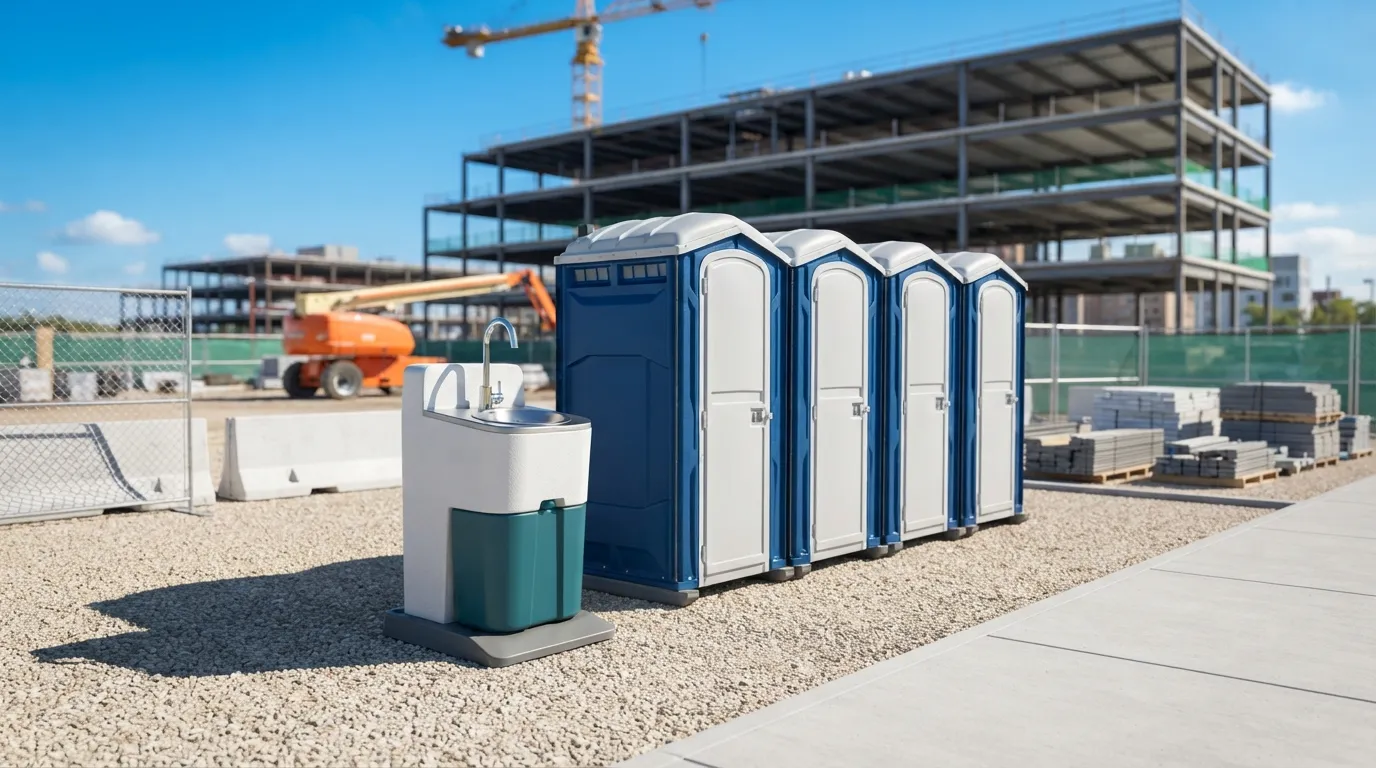
Placement decisions come down to sightlines, cable runs, and truck access, and getting this wrong costs a production a reshoot or a scramble mid-day. A porta potty placement guide covers ground stability and clearance basics, but film sets add a layer: units need to sit outside the widest lens frame planned for the day, and far enough from the sound department's boom range to avoid door-slam noise on a live take. ADA Standards section 405.2 caps ramp slope at 1:12 for any accessible unit needing a ramp on uneven ground, which matters on gravel lots or hillside locations around Hazel Dell, 6.4 miles northwest of Vancouver, or Orchards, 6.4 miles northeast. A roll-off dumpster rental for set strike debris should sit on the opposite side of the lot from base camp, with the 60 feet of straight clearance a delivery truck needs factored into the location scout notes. If the production needs secure gear storage between shoot days, a storage container rental or mobile office trailer rental parks near base camp without blocking the truck route. Crews working overnight setups often add a light tower rental near the restroom cluster, since OSHA 1926.56(a) sets minimum illumination levels for active work areas after dark.
What size restroom trailer fits a small crew?
A 2 stall restroom trailer covers most small commercial and short-form crews under twenty people comfortably. It has enough room for cast and crew without the footprint of a larger unit, and it tows into tighter Vancouver lots than an 8-stall model.
Do we need a generator for a restroom trailer?
Yes, if the location lacks existing power. Restroom trailers run interior lights, pumps, and sometimes climate control, so a portable generator rental for film sets keeps everything running independent of the location's electrical panel.
How far in advance should we book for a shoot?
Book as soon as the location locks, ideally two to three weeks out for multi-day shoots. Last-minute location changes happen; emergency porta potty rental exists for exactly that scramble.
Can we get handwashing stations without full restroom units?
Yes. A hand sanitizer station rental or a full portable sink rental with soap and towels works alongside existing restrooms, and it satisfies 29 CFR 1910.141(d)(2) requirements on its own.
Do you deliver to locations outside Vancouver?
Yes, including sites near Camas, Battle Ground, and Hazel Dell. Check the service areas page for coverage details before locking a rural location into the schedule.
Next step
Get a delivery date
Tell us the address, the dates and the headcount. We size the order and confirm the route.